Salon marketing: Google Maps, Instagram and the booking link
Three places bring clients to a salon: the "salon near me" search, a friend's recommendation and the work on Instagram. How to build each one without a budget.
In short
- A new client reaches a salon from one of three places: a "salon near me" search on Google, somebody's recommendation, or a piece of work they saw on Instagram. All three are free, and all three need steady work, not a campaign.
- Every channel has to end at the same booking link. A Google profile without a link, a bio without a link and an auto-reply without a link are clients who wanted to book and could not.
- You measure once a month: how many new clients, where they came from, and how many came back. Without that number there is no telling which channel works.
Where salon clients really come from
Ask ten new clients how they found you and you will get three answers: "I searched for a salon near home", "a friend recommended you", and "I saw a haircut of yours on Instagram". That is salon marketing. Not billboards and not campaigns, but three channels that are all free and all demand the same thing: a little work, every week, without stopping.
And the three share one rule: they have to end in the same place. A client who found you on Maps and could not find how to book an appointment booked at the next salon. The booking link is not "another channel"; it is the end of every channel.
The Google Business Profile
When someone searches "hair salon" or "barber near me", Google shows a map with three businesses. Being there, with reviews and pictures, is worth more than any other advertising, and it is free. You create or claim the profile and treat it like the shop window:
Checklist
Three mistakes that cost ranking: wrong hours (a client found a closed door and left one star), the wrong category, and asking for reviews in exchange for a discount, which Google forbids and removes.
Instagram that brings appointments, not likes
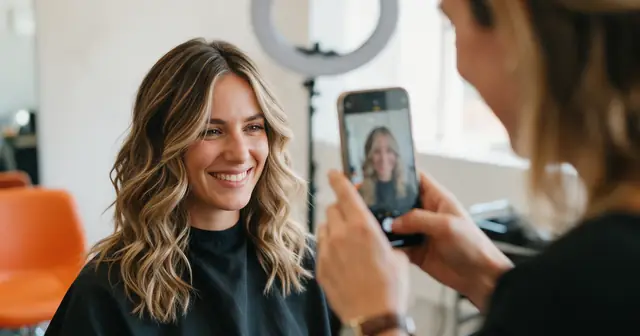
On Instagram a client does not search for a salon; they see a haircut they want. So the profile must show work, not a logo:
- Content: before and after, a short process in a reel, the final result in good light. Two or three a week. Clients' faces only with their consent.
- The bio: what you are, where, and the booking link. Not a "link in bio" that leads to a page of ten links.
- Stories: "a slot opened today at 16:00" with the link. That fills holes in the calendar better than any post.
- Comments and messages: answered the same day, pointing to the link. "Do you have anything tomorrow?" gets a link, not "call us".
- Location: tag the city and the neighbourhood in every post. Whoever searches in your city finds you.
A business account gives data (who watched, from where, when) and a booking button. The data matters more than the button: if most viewers are in another city, the posts are pretty and useless.
WhatsApp, recommendations and the status
A friend's recommendation is the strongest channel, and it does not happen by itself: a happy client recommends when it is easy. Three things help: the booking link (they send it to the friend instead of explaining where you are), a haircut they are proud of, and a "thanks for bringing Joe" next time. A "bring a friend" scheme with a small addition (not a discount on the price) works when it is simple.
WhatsApp itself is a service channel, not advertising: an auto-reply that says "we are with a client — book here without waiting: {link}", a status with today's work, and reminders from the system. Promotions go only to whoever explicitly consented to receive advertising, under the messaging policy and the anti-spam law. We wrote about WhatsApp in an appointment business separately.
The booking link is the marketing engine
Everything above brings people to the door. What brings them in is one page: the booking link. It has to open on a phone, show the services with prices and the free times, and finish an appointment in three or four taps without a sign-up. The 12 things it must have.
| Channel | Where the link goes |
|---|---|
| Google profile | The "appointment" field + the description |
| The bio + every story about a free slot | |
| The auto-reply + the status | |
| Reminders and confirmations | In every message |
| The door and the counter | A QR code |
| The business card | The short address |
And once the client has booked once, marketing ends and retention begins: a reminder before, the next appointment in hand, and a message when five weeks have passed without a visit.
What to measure
Three numbers, once a month, five minutes:
- New clients this month, and for each a "how did you find us?" written on the client card.
- How many of the new ones booked a second appointment within two months. That is the number that says whether the marketing brings the right people.
- How many appointments came through the link versus the phone. If most appointments are still by phone, the link is not visible enough.
A system with an "appointments by channel" report does the third by itself, and a client card with a "source" field does the first. The second is the history.
How it works in Torly
In Torly the booking link is one short address (torly.cc/your-name) that works in the Google profile, the bio and the auto-reply, opens on a phone in the client's language and finishes an appointment in a few taps; a QR code for the door is produced from the settings. The client who booked gets a confirmation and a reminder with a cancellation link, and at the end of the visit you can book them a series. The reports show how many appointments came from the booking site, by phone, from the AI phone agent and from ChatGPT, and the client card keeps "how they found us". Consents to advertising are kept apart from the consent to reminders, so a promotion goes only to whoever wanted it.
Questions and answers
What is the first thing to do in salon marketing?
The Google Business Profile: address, hours, real pictures, the right category and a booking link. That is what appears to whoever searches "salon near me" on Maps, and it is free. Instagram comes after.
How do I get Google reviews?
You ask, every happy client, at the end of the visit, with the direct review link Google gives in the profile. No discount for a review — it is against Google's rules and it shows. You answer every review, the bad ones too, politely and briefly.
How many posts should I publish on Instagram?
Two or three a week of real work (before and after, the process, the result), and a story when there is a free slot today. Consistency matters more than volume; a profile not updated for a month looks closed.
Is paid advertising worth it?
After there is a Google profile with at least ten reviews, an Instagram with work, and a link that works. Paid advertising brings people to a page; if the page does not convert, you paid for nothing. Then you start small, local, and measure.
How do I measure what works?
Ask every new client "how did you find us?" and write it on the client card. At the end of the month count: how many new, from which source, how many of them booked a second appointment. A system with a report by channel does it by itself.
What about WhatsApp?
WhatsApp is a service channel, not advertising: an auto-reply with the booking link, a status with today's work, and reminders. Promotions go only to whoever explicitly consented to receive advertising.
Sources
Updated · By Moti Hanukah
Builds Torly, an appointment scheduling system for small businesses, and works every day with owners who want a full calendar and fewer phone calls. Writes here about what we learn along the way.